Kentucky Bonus Tax Calculator
Data compiled and maintained by Timmy · Updated 2026-10-03
Kentucky bonus tax calculator
How to Calculate Tax on a Bonus in Kentucky (Step by Step)
Walk through the Kentucky bonus tax calculator with a real $10,000 bonus and $70,000 salary example. Each screenshot shows exactly what to type and which option to pick, so you can see what lands in your account on payday.
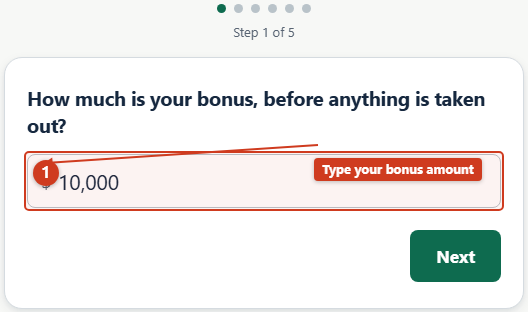
Enter your bonus amount
On the first card, type the bonus you received before any tax was taken out. Here we use a $10,000 bonus.
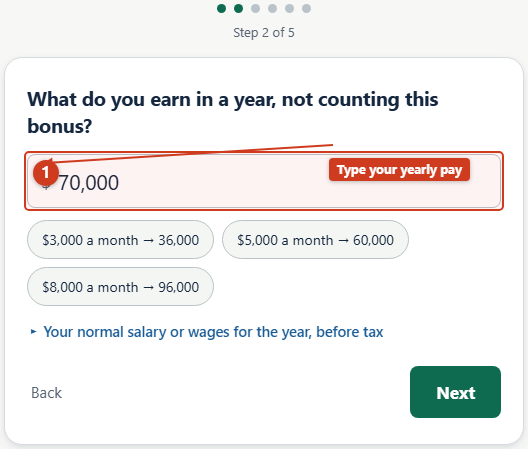
Enter your yearly pay
Click Next and type your annual salary, not counting this bonus. We use $70,000 a year.
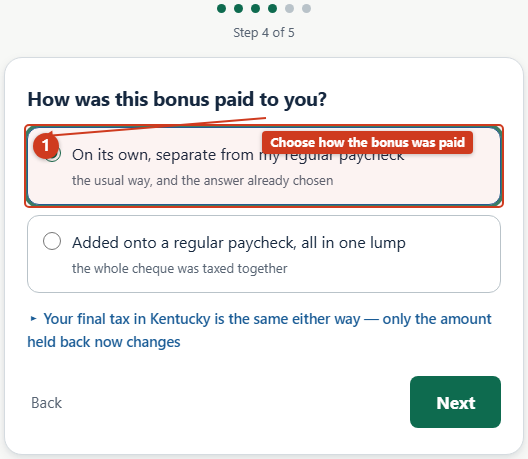
Choose how the bonus was paid
Click Next through filing status. On the payment card, pick how the bonus was paid to you — on its own (the default) or added to a regular paycheck.
Read your estimated take-home bonus
Click Next to the last card. The green figure is your estimated bonus after withholding, with a line-by-line breakdown below it.
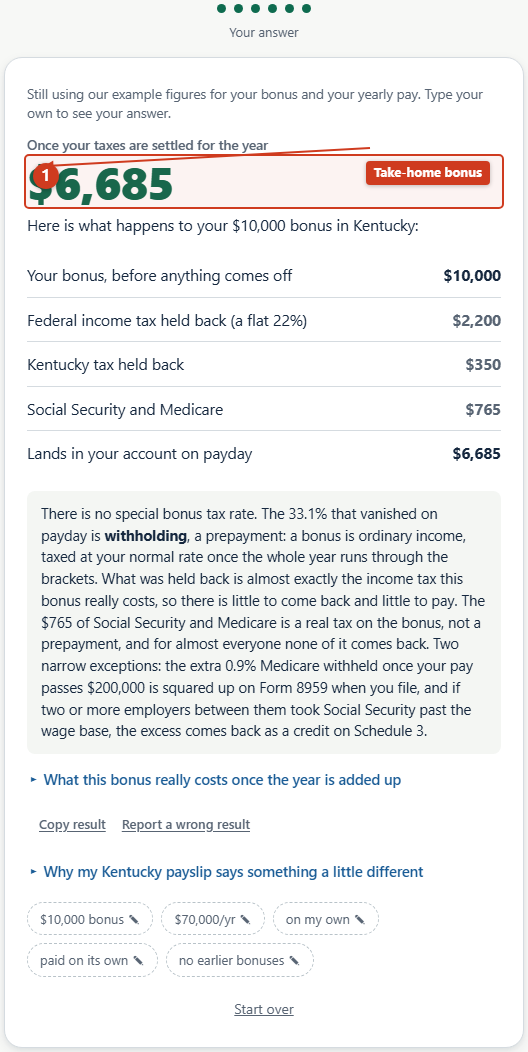
Tip: Enter your bonus and yearly pay, keep single filing and the default 'paid on its own' option, then click through to the answer. The figure is an estimate of take-home bonus pay, not tax advice.
Wondering why your Kentucky bonus shrank so much? It's withholding, a flat prepayment, not a higher rate on bonuses. Kentucky has no separate bonus rate, so it withholds using the aggregate method (about 3.5%) on top of the 22% federal prepayment and FICA. Enter your numbers to see what's held back now beside what the bonus will really cost when you file, and your refund or amount owed. Everything runs in your browser.
Short version: in Kentucky, a bonus paid on its own is withheld at the flat federal 22%, no separate Kentucky rate — it's withheld as ordinary wages (about 3.5%), and 7.65% FICA. Those are withholding rates, not the tax itself; your bonus settles at your marginal rate on your return — the tool above shows by how much.
Estimate only, not tax advice — terms.
Why your Kentucky bonus looks over-taxed — and mostly isn't
"Bonus tax" is a nickname for over-withholding. The 22% is a flat prepayment; your bonus is ordinary income taxed at your marginal rate once the year's brackets are applied. If your real rate sits under 22%, the surplus refunds; if it runs above, you cover the shortfall. In this page's $14,000 example, about $1,410 of what's withheld is really over-payment you'd get back. The lone exception is FICA (7.65%), which is a real tax rather than a prepayment.
$28,000 salary, $14,000 bonus: the Kentucky withholding-vs.-tax breakdown
Say you earn $28,000 in Kentucky and your employer cuts a separate $14,000 bonus check:
- Off the top: $4,641 disappears at payday — $3,080 federal, $490 Kentucky, and $1,071 FICA — so roughly $9,359 actually reaches you, a 33.1% cut.
- The real bill: at filing the bonus is taxed roughly $2,160 in income tax (federal $1,670 + Kentucky $490), with the identical $1,071 FICA on top.
- The gap: about $1,410 of income-tax over-withholding comes back as a refund when you file. Either way, the $1,071 FICA is final and won't come back.
A single-filer illustration only — drop your real salary, bonus, and filing status into the tool above for your figure.
How Kentucky bonus withholding stacks up against Tennessee, Ohio and Indiana
Here's a $10,000 bonus on a $70,000 salary compared across Kentucky and nearby Tennessee, Ohio and Indiana:
| State | Bonus method | State withheld | Total withheld |
|---|---|---|---|
| Kentucky | aggregate (~3.5%) | $350 | $3,315 |
| Tennessee | no state income tax | $0 | $2,965 |
| Ohio | flat 2.75% | $275 | $3,240 |
| Indiana | aggregate (~2.95%) | $295 | $3,260 |
Total = federal 22% + state + FICA. Illustrative single-filer figures; the income tax you actually owe trues up at filing.
Kentucky bonus withholding at $5,000, $25,000 and $100,000
What's held back from three bonus sizes in Kentucky (single filer, $70,000 salary):
| Bonus | Federal | Kentucky | FICA | Total | % of bonus |
|---|---|---|---|---|---|
| $5,000 | $1,100 | $175 | $383 | $1,658 | 33.1% |
| $25,000 | $5,500 | $875 | $1,913 | $8,288 | 33.1% |
| $100,000 | $22,000 | $3,500 | $7,650 | $33,150 | 33.1% |
That percentage moves once Social Security caps out at the wage base, and the income-tax slice still settles at filing.
Kentucky bonus withholding, piece by piece
Federal withholding on a bonus. The IRS default holds back a flat 22% for federal income tax when the bonus is separate from your regular pay (IRS Pub 15). It rises to a mandatory 37% on any bonus dollars past $1,000,000 in a year — the third bracket's rate as a default, not a bonus tax.
Kentucky: no separate bonus rate. With no published supplemental rate, Kentucky withholds a bonus using the aggregate method — combined with your regular pay. Its flat 3.5% income tax means a separately paid bonus is withheld close to 3.5%.
FICA is the real tax. Social Security (6.2% to the wage base) and Medicare (1.45%, +0.9% above $200,000) are owed at the same rate they're withheld. The income-tax withholding is the only part that can come back — the FICA share is settled the moment it's taken.
The Kentucky paycheck calculator covers take-home pay on a normal Kentucky paycheck.
Kentucky bonus tax FAQ
How much is withheld from a bonus in Kentucky for 2026?
On a separately paid bonus, Kentucky takes about 3.5% (aggregate method), the federal side takes a flat 22% (37% beyond $1,000,000/yr), and FICA takes 7.65%. Those are withholding rates that settle up when you file — not a final tax.
Why might I owe tax on my Kentucky bonus at filing?
Because 22% is only a prepayment. If your true marginal rate is above 22% (high earners), the flat withholding falls short and you owe the rest; below 22%, you're over-withheld and get money back.
Does Kentucky have a separate bonus withholding rate?
No. Kentucky has no separate supplemental rate, so a bonus is withheld with the aggregate method — as if it were part of your regular wages, effectively near 3.5%.
Is there a special bonus tax rate in Kentucky?
No. The 22% federal and the state supplemental rate are withholding defaults, not rates that apply only to bonuses. Your real tax is your ordinary marginal rate.
Bonus tax calculators near Kentucky
Kentucky paycheck calculator · all state bonus tax calculators →
Sources
How we sourced these numbers
Every figure on this page is calculated, not estimated by hand. Federal income-tax withholding follows the IRS Publication 15-T (Federal Income Tax Withholding Methods), which is the method employers use to turn your W-4 and pay into a per-paycheck withholding amount. Brackets and the standard deduction come from the IRS annually; Social Security and Medicare rates and the wage base come from the Social Security Administration; state figures come from each state's revenue or labour agency, linked below. A person updates the underlying tax data and the calculator recomputes every figure at build time. This is an estimate for planning, not tax advice.
- IRS Publication 15 (2026) — Supplemental Wages (flat 22% / 37% above $1M)
- Kentucky supplemental rate: Kentucky Department of Revenue, 42A003 Withholding Kentucky Income Tax Instructions for Employers (revised March 2026): all Kentucky wage earners are taxed at a flat 3.5% rate, and bonuses are subject to withholding.