Indiana Bonus Tax Calculator
Data compiled and maintained by Timmy · Updated 2026-10-03
Indiana bonus tax calculator
How to Calculate Tax on a Bonus in Indiana (Step by Step)
Walk through the Indiana bonus tax calculator with a real $10,000 bonus and $70,000 salary example. Each screenshot shows exactly what to type and which option to pick, so you can see what lands in your account on payday.
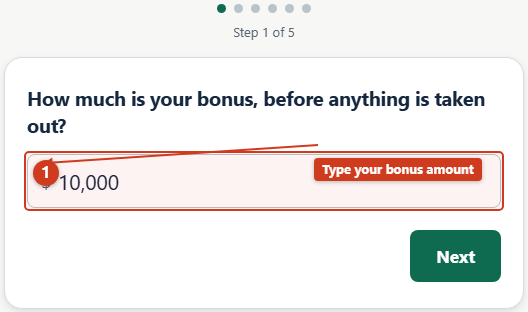
Enter your bonus amount
On the first card, type the bonus you received before any tax was taken out. Here we use a $10,000 bonus.
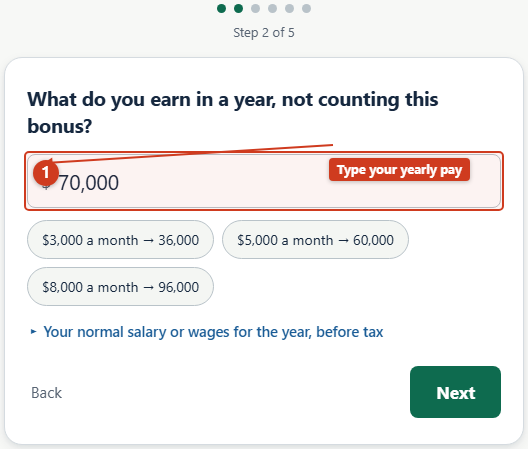
Enter your yearly pay
Click Next and type your annual salary, not counting this bonus. We use $70,000 a year.
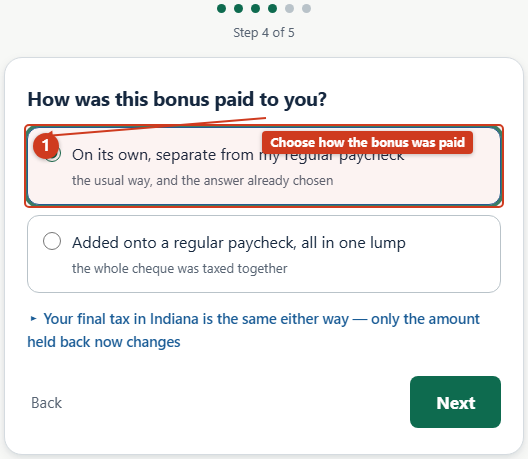
Choose how the bonus was paid
Click Next through filing status. On the payment card, pick how the bonus was paid to you — on its own (the default) or added to a regular paycheck.
Read your estimated take-home bonus
Click Next to the last card. The green figure is your estimated bonus after withholding, with a line-by-line breakdown below it.
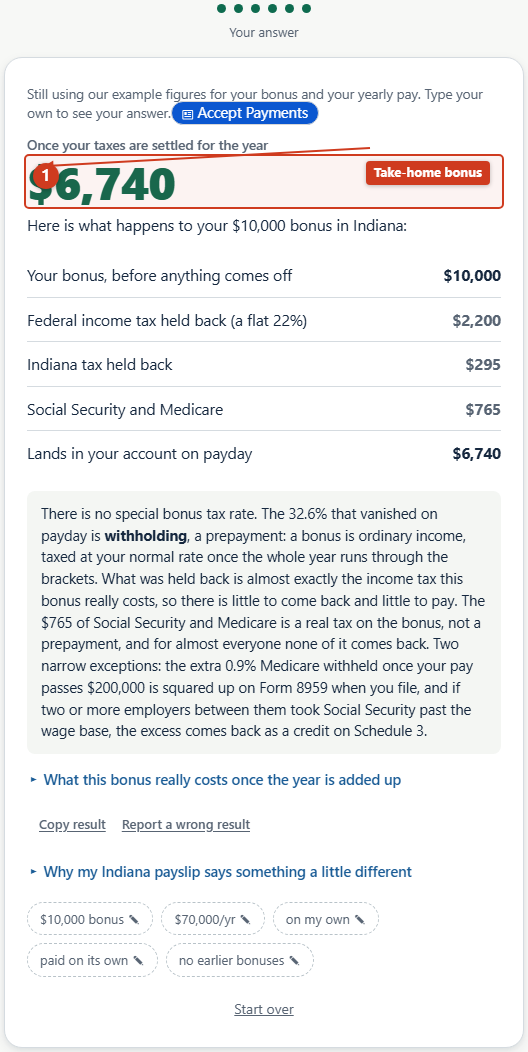
Tip: Enter your bonus and yearly pay, keep single filing and the default 'paid on its own' option, then click through to the answer. The figure is an estimate of take-home bonus pay, not tax advice.
Your Indiana bonus is ordinary income; the payday deduction is a flat withholding prepayment, not a higher rate. Indiana has no separate bonus rate, so it withholds using the aggregate method (about 2.95%) on top of the 22% federal prepayment and FICA. Drop your figures in to watch the payday deduction sit next to the real filing cost, plus whatever you get back or owe. Everything runs in your browser.
Quick answer: a separately paid bonus in Indiana is withheld at a flat 22% for federal income tax plus no separate Indiana rate — it's withheld as ordinary wages (about 2.95%), plus 7.65% FICA. But that's only withholding. Your real bill is your marginal rate at filing; run the calculator to see the refund or shortfall.
Estimate only, not tax advice — terms.
What comes out of a Indiana bonus in 2026
Federal withholding on a bonus. The IRS default holds back a flat 22% for federal income tax when the bonus is separate from your regular pay (IRS Pub 15). Bonus dollars over $1,000,000 in the year switch to a mandatory 37%; below that it's a flat 22% prepayment tied to the third bracket.
Indiana folds the bonus into regular pay. Lacking a flat supplemental rate, Indiana uses the aggregate method: withholding is figured on your wages plus the bonus. At its 2.95% flat rate, that lands a bonus near 2.95%.
Set FICA aside as final. The 7.65% FICA bite is the tax itself — Social Security stops at the annual wage base, Medicare doesn't. It reads the same in the "now" and "at tax time" columns because none of it comes back — just the income-tax slice is a prepayment that reconciles.
Need your normal take-home instead? Try the Indiana paycheck calculator.
Is Indiana's the aggregate method (~2.95%) bonus rate a "bonus tax"? No
Nothing about a bonus changes the tax rate — it changes the withholding. The bonus is stacked onto your other income and taxed at your marginal rate, not at a bonus-only rate. If your real rate sits under 22%, the surplus refunds; if it runs above, you cover the shortfall. On the $4,500 example below, roughly $450 is over-withheld and comes back to you at filing. Just the 7.65% FICA slice is a real tax you won't get back.
Run the numbers on a $4,500 bonus for a $36,000 earner in Indiana
Here's how a $4,500 bonus plays out for a single filer making $36,000 in Indiana:
- Withheld now: $990 federal (22%) + $133 Indiana + $344 FICA = $1,467 held back, leaving about $3,033 in hand — a 32.6% bite.
- At tax time: the bonus's actual income tax works out near $673 (federal $540 + Indiana $133) — and FICA is the same $344 as before.
- The gap: you over-paid income tax by roughly $450, and that returns as a refund at filing. FICA ($344) stays either way — it's a real tax.
Illustrative single-filer figures from this page's engine; your result depends on your total income and filing status.
Indiana vs. Illinois, Ohio and Michigan: bonus withholding compared
Take a $10,000 bonus for someone on $70,000 and compare Indiana with bordering Illinois, Ohio and Michigan:
| State | Bonus method | State withheld | Total withheld |
|---|---|---|---|
| Indiana | aggregate (~2.95%) | $295 | $3,260 |
| Illinois | aggregate (~4.95%) | $495 | $3,460 |
| Ohio | flat 2.75% | $275 | $3,240 |
| Michigan | flat 4.25% | $425 | $3,390 |
Total combines the 22% federal, the state line, and FICA. Single-filer estimates — your real income tax settles when you file.
Indiana bonus withholding at $5,000, $25,000 and $100,000
Three bonuses — $5,000, $25,000, $100,000 — and what Indiana withholds from each on a $70,000 salary:
| Bonus | Federal | Indiana | FICA | Total | % of bonus |
|---|---|---|---|---|---|
| $5,000 | $1,100 | $148 | $383 | $1,630 | 32.6% |
| $25,000 | $5,500 | $738 | $1,913 | $8,150 | 32.6% |
| $100,000 | $22,000 | $2,950 | $7,650 | $32,600 | 32.6% |
The rate drifts as Social Security hits its annual cap, but the income-tax part still reconciles at filing.
Indiana bonus tax FAQ
Is a Indiana bonus taxed differently from my salary?
Not in the end. It may be withheld differently (a flat rate up front), but at filing a bonus is taxed exactly like the rest of your income, at your marginal rate.
What is the Indiana bonus tax rate in 2026?
Indiana withholds about 2.95% (aggregate method) on a separately paid bonus, on top of the flat 22% federal rate (37% above $1,000,000/yr) and 7.65% FICA. That's withholding, not your final tax.
Does my Indiana bonus ever come back at tax time?
The income-tax part can. If the flat 22% over-withheld relative to your real marginal rate, the excess is refunded; if you're a high earner above 22%, you pay more. FICA is never refunded.
Does Indiana have a separate bonus withholding rate?
No. Indiana has no separate supplemental rate, so a bonus is withheld with the aggregate method — as if it were part of your regular wages, effectively near 2.95%.
Bonus tax calculators near Indiana
Indiana paycheck calculator · all state bonus tax calculators →
Sources
How we sourced these numbers
Every figure on this page is calculated, not estimated by hand. Federal income-tax withholding follows the IRS Publication 15-T (Federal Income Tax Withholding Methods), which is the method employers use to turn your W-4 and pay into a per-paycheck withholding amount. Brackets and the standard deduction come from the IRS annually; Social Security and Medicare rates and the wage base come from the Social Security Administration; state figures come from each state's revenue or labour agency, linked below. A person updates the underlying tax data and the calculator recomputes every figure at build time. This is an estimate for planning, not tax advice.