Utah Bonus Tax Calculator
Data compiled and maintained by Timmy · Updated 2026-10-03
Utah bonus tax calculator
How to Calculate Tax on a Bonus in Utah (Step by Step)
Walk through the Utah bonus tax calculator with a real $10,000 bonus and $70,000 salary example. Each screenshot shows exactly what to type and which option to pick, so you can see what lands in your account on payday.
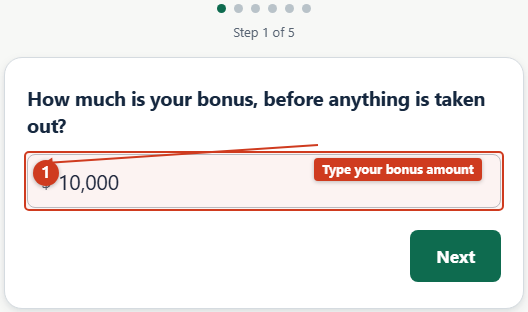
Enter your bonus amount
On the first card, type the bonus you received before any tax was taken out. Here we use a $10,000 bonus.
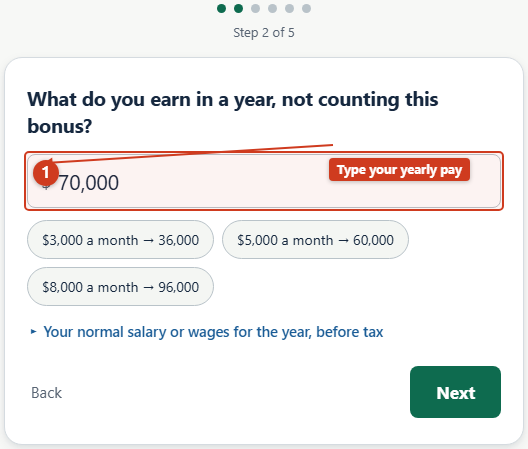
Enter your yearly pay
Click Next and type your annual salary, not counting this bonus. We use $70,000 a year.
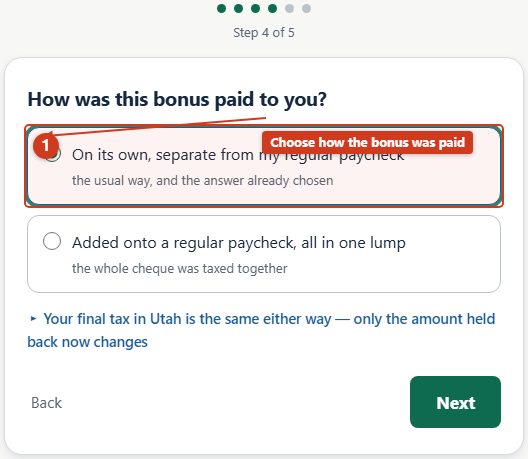
Choose how the bonus was paid
Click Next through filing status. On the payment card, pick how the bonus was paid to you — on its own (the default) or added to a regular paycheck.
Read your estimated take-home bonus
Click Next to the last card. The green figure is your estimated bonus after withholding, with a line-by-line breakdown below it.
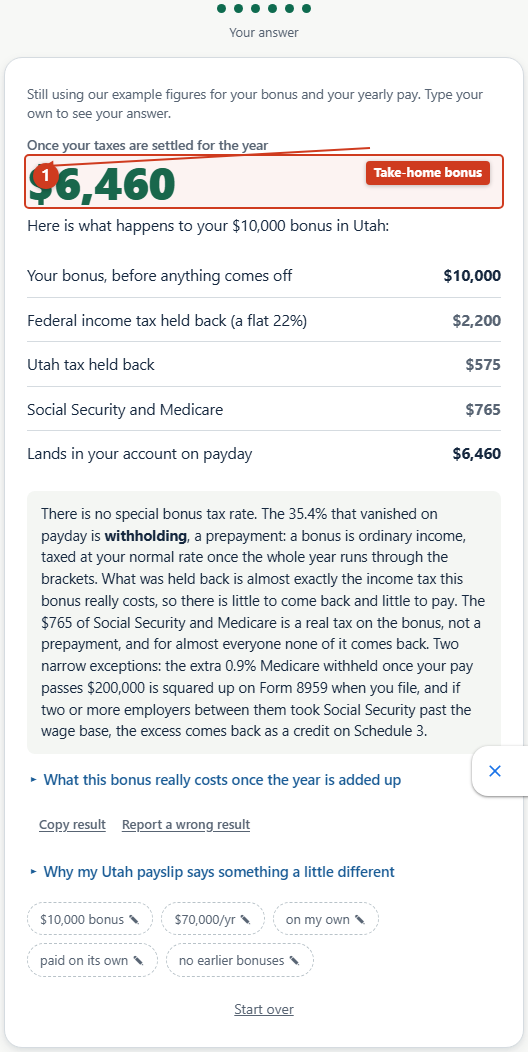
Tip: Enter your bonus and yearly pay, keep single filing and the default 'paid on its own' option, then click through to the answer. The figure is an estimate of take-home bonus pay, not tax advice.
A Utah bonus feels heavily taxed, but the missing chunk is withholding, not a bonus tax. Utah has no separate bonus rate, so it withholds using the aggregate method (about 4.45%) on top of the 22% federal prepayment and FICA. Type in your salary and bonus above and the tool lines up today's withholding against your true tax, with the refund or balance due. Everything runs in your browser.
The quick take: a stand-alone Utah bonus has a flat 22% federal tax withheld, no separate Utah rate — it's withheld as ordinary wages (about 4.45%), plus 7.65% FICA. Treat it as money on account. The real tax is your marginal rate, reconciled on your return; the tool above shows the gap either way.
Estimate only, not tax advice — terms.
Three bonus sizes in Utah: $5,000, $25,000 and $100,000 withheld
Three bonuses — $5,000, $25,000, $100,000 — and what Utah withholds from each on a $70,000 salary:
| Bonus | Federal | Utah | FICA | Total | % of bonus |
|---|---|---|---|---|---|
| $5,000 | $1,100 | $288 | $383 | $1,770 | 35.4% |
| $25,000 | $5,500 | $1,405 | $1,913 | $8,818 | 35.3% |
| $100,000 | $22,000 | $4,743 | $7,650 | $34,393 | 34.4% |
The % shifts as Social Security stops at the wage base; the income-tax portion still trues up when you file.
Run the numbers on a $6,500 bonus for a $28,000 earner in Utah
Take a single filer in Utah earning $28,000 who gets a $6,500 bonus on its own check:
- Off the top: $2,301 disappears at payday — $1,430 federal, $374 Utah, and $497 FICA — so roughly $4,199 actually reaches you, a 35.4% cut.
- What it actually costs: the true income tax on the bonus is about $1,144 (federal $770 + Utah $374), plus the same $497 FICA.
- The gap: about $660 of income-tax over-withholding comes back as a refund when you file. FICA ($497) stays either way — it's a real tax.
Example single-filer numbers from the calculator above; your own refund or bill shifts with your total income and filing status.
Is Utah's the aggregate method (~4.45%) bonus rate a "bonus tax"? No
Think of the flat rate as a deposit, not a bill. A bonus is taxed like any wages — at your marginal rate when the year's income runs through the brackets — and the 22% is only how it's withheld. Under 22% (most people) the extra comes back as a refund; over 22% you owe the difference. Worked out for the $6,500 bonus here, about $660 returns as a refund. Only FICA (7.65%) is a true tax that never returns.
Cross-border check: Utah vs. Colorado, Nevada and Arizona on a bonus
Here's a $10,000 bonus on a $70,000 salary compared across Utah and nearby Colorado, Nevada and Arizona:
| State | Bonus method | State withheld | Total withheld |
|---|---|---|---|
| Utah | aggregate (~4.45%) | $575 | $3,540 |
| Colorado | aggregate (~4.4%) | $440 | $3,405 |
| Nevada | no state income tax | $0 | $2,965 |
| Arizona | Form A-4 rate (2.0% default) | $200 | $3,165 |
Totals stack federal 22%, state, and FICA for a single filer — the actual income tax lands when the return is filed.
What comes out of a Utah bonus in 2026
The federal side is a flat prepayment. A bonus on its own check has 22% withheld for federal income tax (IRS Pub 15). Only the part of your yearly bonuses above $1,000,000 is withheld at 37%; everything under that stays a flat 22% — a shortcut, not a rate reserved for bonuses.
Utah folds the bonus into regular pay. Lacking a flat supplemental rate, Utah uses the aggregate method: withholding is figured on your wages plus the bonus. At its 4.45% flat rate, that lands a bonus near 4.45%.
The 7.65% is real. FICA — Social Security up to the wage base, plus 1.45% Medicare (and 0.9% more above $200,000) — is owed at exactly the rate it's withheld. It reads the same in the "now" and "at tax time" columns because none of it comes back — just the income-tax slice is a prepayment that reconciles.
Need your normal take-home instead? Try the Utah paycheck calculator.
Utah bonus tax FAQ
Does Utah have a separate bonus withholding rate?
No. Utah has no separate supplemental rate, so a bonus is withheld with the aggregate method — as if it were part of your regular wages, effectively near 4.45%.
Why might I owe tax on my Utah bonus at filing?
Because 22% is only a prepayment. If your true marginal rate is above 22% (high earners), the flat withholding falls short and you owe the rest; below 22%, you're over-withheld and get money back.
What is the Utah bonus tax rate in 2026?
Utah withholds about 4.45% (aggregate method) on a separately paid bonus, on top of the flat 22% federal rate (37% above $1,000,000/yr) and 7.65% FICA. That's withholding, not your final tax.
Is a Utah bonus taxed differently from my salary?
Not in the end. It may be withheld differently (a flat rate up front), but at filing a bonus is taxed exactly like the rest of your income, at your marginal rate.
Bonus tax calculators near Utah
Utah paycheck calculator · all state bonus tax calculators →
Sources
How we sourced these numbers
Every figure on this page is calculated, not estimated by hand. Federal income-tax withholding follows the IRS Publication 15-T (Federal Income Tax Withholding Methods), which is the method employers use to turn your W-4 and pay into a per-paycheck withholding amount. Brackets and the standard deduction come from the IRS annually; Social Security and Medicare rates and the wage base come from the Social Security Administration; state figures come from each state's revenue or labour agency, linked below. A person updates the underlying tax data and the calculator recomputes every figure at build time. This is an estimate for planning, not tax advice.
- IRS Publication 15 (2026) — Supplemental Wages (flat 22% / 37% above $1M)
- Utah supplemental rate: Utah State Tax Commission Publication 14 (Withholding Tax Guide, Rev. 4/26): every withholding schedule reads '2. Multiply line 1 by .0445 (4.45%)'