Pennsylvania Paycheck Calculator
Last updated:
$75,000 a year in Pennsylvania: what is the 2026 take-home pay?
In Pennsylvania for 2026, a $75,000 salary takes home about $59,238 per year after federal income tax and FICA (Social Security and Medicare), and Pennsylvania state income tax and PA unemployment insurance contributions.
Pennsylvania take-home pay calculator
Take-home now: $2,278.37 per 2 weeks
How to Calculate Your Pennsylvania Take-Home Pay (Step by Step)
Walk through the Pennsylvania paycheck calculator with a real $85,000 salary example. Each screenshot shows exactly what to type and which option to pick, so you can read your own estimated take-home pay with confidence.
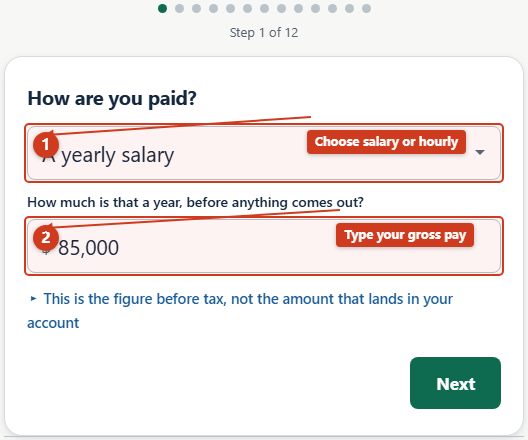
Open the calculator and enter your pay
Start on the first card. Choose how you are paid (salary or hourly) and type your gross pay. Here we use a $85,000 annual salary.
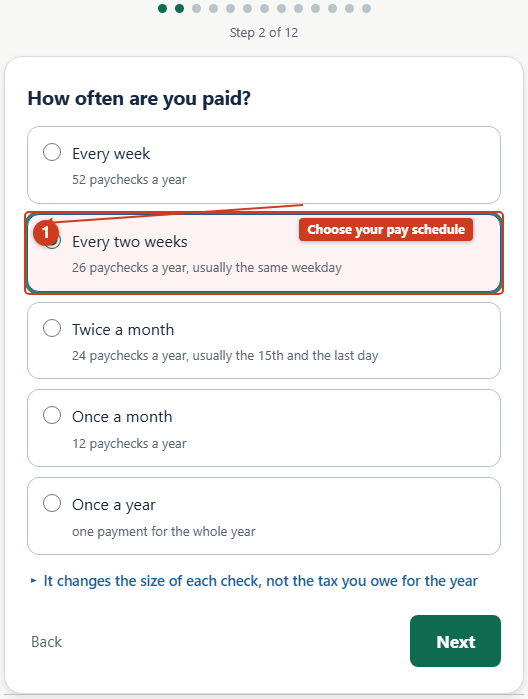
Pick how often you are paid
Click Next and select your pay schedule. Biweekly (26 paychecks a year) is selected in this example.
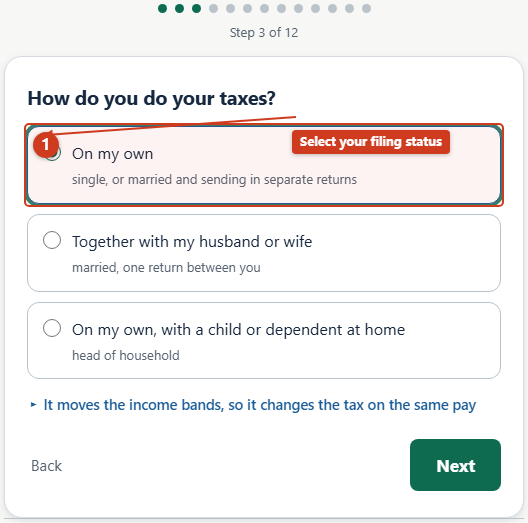
Answer the remaining tax questions
Click Next through filing status, tips, overtime, bonus, retirement and dependents. Pick the option that matches your situation; the defaults below are used here.
Read your estimated take-home pay
Keep clicking Next to the last card. Your estimated net pay per paycheck appears in the green answer band, with a full breakdown of federal, FICA and Pennsylvania deductions below it.
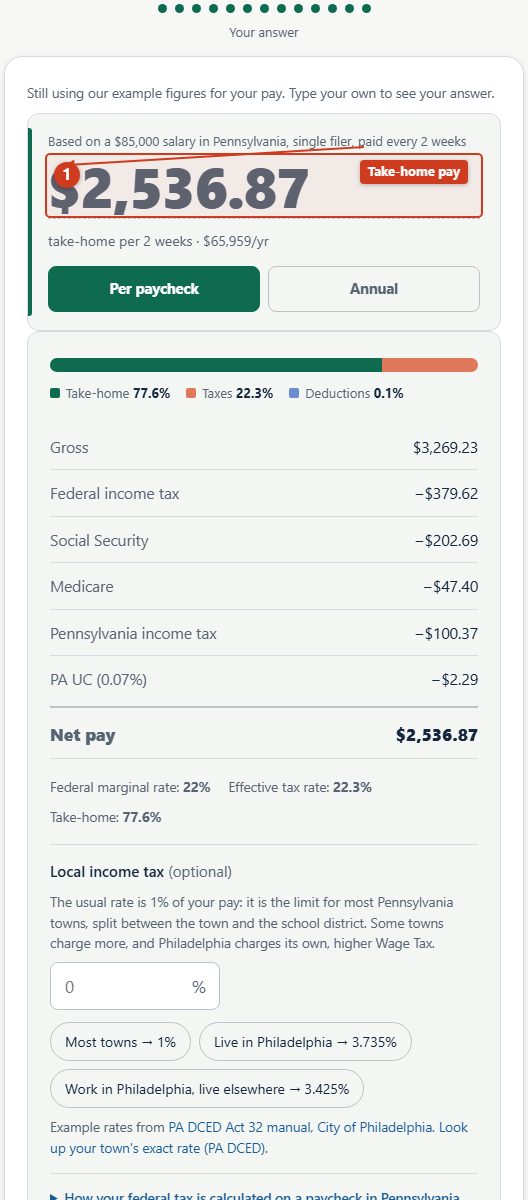
Tip: Enter a yearly salary of $85,000, keep biweekly pay and single filing status, then click through the questions. The result updates instantly — no submit button. Figures are an estimate for planning, not tax advice.
Free Pennsylvania salary-after-taxes and income tax calculator — a no-signup, in-browser alternative to paid tools like SmartAsset and ADP. Estimate your 2026 take-home pay for any salary, hourly rate, or pay frequency.
Use this free Pennsylvania (PA) paycheck, payroll and income tax calculator to estimate your 2026 take-home pay after federal income tax, Social Security, Medicare, and Pennsylvania's flat 3.07% state income tax.
Use the calculator for your own salary or hourly rate.
Pennsylvania income tax rate 2026
Pennsylvania's 2026 state income tax is a flat 3.07%.
How Pennsylvania's flat 3.07% income tax hits your 2026 paycheck
Pennsylvania levies a flat 3.07% state income tax for 2026 on your wages, with no state standard deduction. This calculator applies that on top of federal withholding and Social Security / Medicare to estimate your Pennsylvania take-home pay.
Pennsylvania does not provide a state standard deduction; all taxable income is taxed at the single flat rate of 3.07% — Pennsylvania does not use graduated brackets for 2026. As a worked example, a single filer earning $60,000 pays about $1,842 in Pennsylvania income tax (roughly 3.1% of gross) before federal tax and FICA.
What this estimate doesn't include: Your local earned income tax (set by your town and school district) and Philadelphia's Wage Tax (3.735% if you live there and 3.425% if you only work there since 1 July 2026, 3.74% and 3.43% before that) are included only if you enter your rate in the Local income tax box above. Many Pennsylvania municipalities also withhold a Local Services Tax where you work. State law caps it at $52 a year and it comes out a little at a time each pay period. It depends on your work municipality, so it is not computed here. Pennsylvania taxes the money you put into a 401(k) or 403(b), so this estimate does not subtract those contributions from your Pennsylvania taxable pay. Pre-tax health insurance premiums still lower it. Dependent care contributions are taxed by Pennsylvania too, which this estimate does not account for. Court-ordered deductions, union dues, and anything else your specific employer withholds are not in this figure, and a local income tax is in it only if you enter your rate; your pay stub is the authority on those.
Estimates only, not tax advice. The section "What this estimate doesn't include" above lists what's left out; see also our terms and the corrections log.
One rate on every taxable dollar: Pennsylvania's 3.07% flat tax (2026)
Pennsylvania applies a single flat rate to taxable wages for 2026.
| Filing | Rate |
|---|---|
| All taxable income | 3.07% |
Unemployment Compensation: what else Pennsylvania takes from your check
On a Pennsylvania paycheck, these state programs are deducted in addition to income tax and Social Security / Medicare:
| Program | Employee rate (2026) | Wage base / cap |
|---|---|---|
| Unemployment Compensation (employee withholding) | 0.07% | No wage cap — applies to all gross wages (70 cents per $1,000) |
Included in your take-home: the PA UC contribution is subtracted from the take-home estimate at the top of this page. These are withheld after tax and do not lower your taxable income.
Local income taxes in Pennsylvania
Nearly every PA municipality and school district levies a local Earned Income Tax (EIT) under Act 32, typically 1% combined in suburbs (split municipality/school district). Philadelphia imposes a separate Wage Tax (not EIT): 3.74% residents / 3.43% nonresidents through June 30, 2026, then 3.735% residents / 3.425% nonresidents effective July 1, 2026 (the first step of a five-year cut plan trending toward ~3.70%/3.39%). There is also a Local Services Tax (LST) charged where you work, which state law caps at $52 per person per year no matter how many jobs you hold. EIT rates range roughly 0% to ~3.84% statewide; DCED maintains the official rate register.
Your paycheck vs the $77,545 Pennsylvania median
| Median household income (2024 (ACS 1-year)) | $77,545 |
| Take-home (single filer) | ≈$60,948 |
Beyond the paycheck: Pennsylvania's 6% statewide sales tax
| Statewide sales tax | 6% |
Is overtime and tips tax-free in Pennsylvania? Federally yes, but Pennsylvania still taxes both
Federal law lets you deduct qualified tips and overtime premium pay from 2025 through 2028 (OBBBA caps & rules), though Social Security and Medicare are still withheld.
Pennsylvania state income tax: Pennsylvania has not adopted the federal tips/overtime deductions for state income tax as of mid-2026, so they reduce your federal tax only. (source: pa.gov)
- Overtime: 2025 — not deductible on your Pennsylvania return (still state-taxed); 2026–2028 — not deductible on your Pennsylvania return (still state-taxed).
- Tips: 2025 — not deductible on your Pennsylvania return (still state-taxed); 2026–2028 — not deductible on your Pennsylvania return (still state-taxed).
Related: overtime calculator · tips by state · overtime by state · tips calculator.
Two Pennsylvania payroll quirks worth knowing
- Pennsylvania is one of the only states that withholds an employee-side unemployment tax: 0.07% of ALL gross wages with no wage cap, taken from every paycheck on top of state and local income tax.
- PA's 3.07% state rate is flat with no standard deduction or personal exemption, so it applies from the first dollar of taxable compensation — and a Philadelphia resident also pays the city Wage Tax, 3.735% for residents and 3.425% for non-residents effective July 1, 2026, for a combined ~6.81% wage tax before federal.
Pennsylvania stays on the federal $7.25 minimum wage in 2026
$7.25/hour (≈$15,080/year full-time). Pennsylvania's minimum wage is $7.25 an hour for 2026, the same as the federal minimum.
Pennsylvania paycheck FAQ
Does Pennsylvania have a state income tax in 2026?
Yes — a flat 3.07% on taxable wages in 2026, on top of federal tax and FICA.
Why is my take-home pay smaller than my salary in Pennsylvania?
Three things come off the top: federal income tax, FICA (6.2% Social Security up to the annual wage base, plus 1.45% Medicare with no cap) and state income tax. Your W-4 allowances and any pre-tax deductions such as a 401(k) change the figure, so two people on the same Pennsylvania salary can take home different amounts.
How much federal income tax is withheld from a Pennsylvania paycheck?
It depends on your pay, filing status and W-4 settings — not a flat rate. The employer uses the IRS percentage method (Publication 15-T): each paycheck is annualised, the 2026 standard deduction ($16,100 for a single filer) is accounted for, and the result is run through the federal brackets, which top out at 37%. That is a prepayment of your annual tax, trued up when you file.
Do cities or counties in Pennsylvania take a local income tax out of paychecks?
Nearly every PA municipality and school district levies a local Earned Income Tax (EIT) under Act 32, typically 1% combined in suburbs (split municipality/school district). Philadelphia imposes a separate Wage Tax (not EIT): 3.74% residents / 3.43% nonresidents through June 30, 2026, then 3.735% residents / 3.425% nonresidents effective July 1, 2026 (the first step of a five-year cut plan trending toward ~3.70%/3.39%). There is also a Local Services Tax (LST) charged where you work, which state law caps at $52 per person per year no matter how many jobs you hold. EIT rates range roughly 0% to ~3.84% statewide; DCED maintains the official rate register. To include yours, enter your town's rate (or Philadelphia's) in the calculator at the top of this page.
Compare a paycheck next door: New York, New Jersey & Ohio
| State | State income tax (2026) | Take-home on $75,000 (single) |
|---|---|---|
| Pennsylvania | flat 3.07% | $59,238 |
| New York | nine brackets, 3.9%–10.9% | $57,784 |
| New Jersey | seven brackets, 1.4%–10.75% | $58,491 |
| Ohio | two brackets, 0%–2.75% | $59,974 |
| Maryland | ten brackets, 2%–6.5% | $58,242 |
Those are the states next door. To see where Pennsylvania lands against all of them at once, our take-home pay by state study runs an identical salary at two levels, $75,000 and $100,000, through the 2026 rules of every state and DC, except Arizona, Arkansas, Idaho, Maryland, Ohio and Vermont, still on their 2025 tables, ranked from the most take-home pay to the least.
All state paycheck calculators →
Data compiled and maintained by Timmy · Updated
Sources
How we sourced these numbers
Every figure on this page is calculated, not estimated by hand. Federal income-tax withholding follows the IRS Publication 15-T (Federal Income Tax Withholding Methods), which is the method employers use to turn your W-4 and pay into a per-paycheck withholding amount. Brackets and the standard deduction come from the IRS annually; Social Security and Medicare rates and the wage base come from the Social Security Administration; state figures come from each state's revenue or labour agency, linked below. A person updates the underlying tax data and the calculator recomputes every figure at build time. This is an estimate for planning, not tax advice.