New Hampshire Bonus Tax Calculator
Data compiled and maintained by Timmy · Updated 2026-10-03
New Hampshire bonus tax calculator
How to Calculate Tax on a Bonus in New Hampshire (Step by Step)
Walk through the New Hampshire bonus tax calculator with a real $10,000 bonus and $70,000 salary example. Each screenshot shows exactly what to type and which option to pick, so you can see what lands in your account on payday.
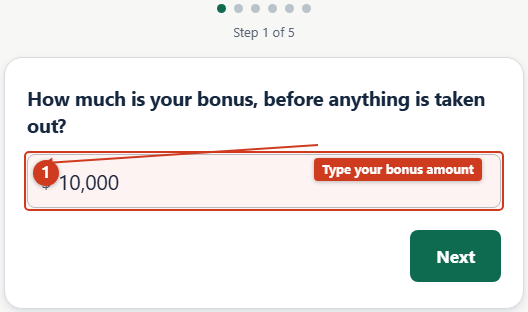
Enter your bonus amount
On the first card, type the bonus you received before any tax was taken out. Here we use a $10,000 bonus.
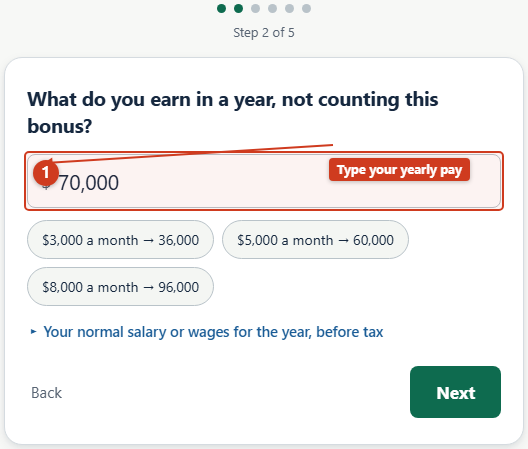
Enter your yearly pay
Click Next and type your annual salary, not counting this bonus. We use $70,000 a year.
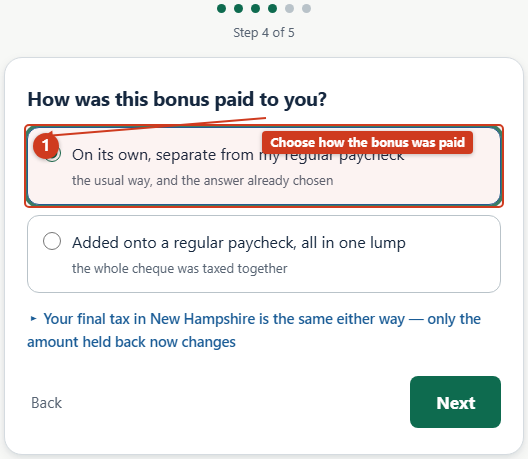
Choose how the bonus was paid
Click Next through filing status. On the payment card, pick how the bonus was paid to you — on its own (the default) or added to a regular paycheck.
Read your estimated take-home bonus
Click Next to the last card. The green figure is your estimated bonus after withholding, with a line-by-line breakdown below it.
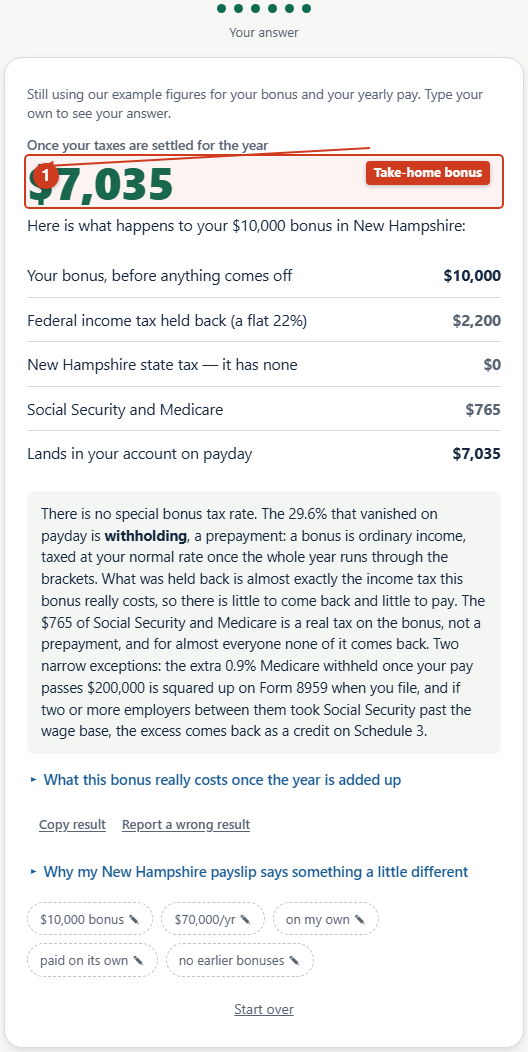
Tip: Enter your bonus and yearly pay, keep single filing and the default 'paid on its own' option, then click through to the answer. The figure is an estimate of take-home bonus pay, not tax advice.
Wondering why your New Hampshire bonus shrank so much? It's withholding, a flat prepayment, not a higher rate on bonuses. New Hampshire takes no state income tax (it runs on taxes such as its 8.5% tax on restaurant meals, hotel rooms and car rentals), so only the flat 22% federal prepayment and FICA come out. Put in your figures above to compare what's withheld now with your real tax at filing — and the refund or shortfall. Everything runs in your browser.
Quick answer: a separately paid bonus in New Hampshire is withheld at a flat 22% for federal income tax plus nothing for the state, because New Hampshire levies no income tax, plus 7.65% FICA. Treat it as money on account. The real tax is your marginal rate, reconciled on your return; the tool above shows the gap either way.
Estimate only, not tax advice — terms.
$47,000 salary, $9,000 bonus: the New Hampshire withholding-vs.-tax breakdown
Here's how a $9,000 bonus plays out for a single filer making $47,000 in New Hampshire:
- Withheld now: $1,980 federal (22%) + $0 state + $689 FICA = $2,669 held back, leaving about $6,332 in hand — a 29.6% bite.
- The real bill: at filing the bonus is taxed roughly $1,080 in income tax (federal $1,080), with the identical $689 FICA on top.
- The gap: about $900 of income-tax over-withholding comes back as a refund when you file. The $689 FICA doesn't move — that part is owed no matter what.
A single-filer illustration only — drop your real salary, bonus, and filing status into the tool above for your figure.
Bonus withholding in New Hampshire next to Massachusetts, Maine and Vermont
Take a $10,000 bonus for someone on $70,000 and compare New Hampshire with bordering Massachusetts, Maine and Vermont:
| State | Bonus method | State withheld | Total withheld |
|---|---|---|---|
| New Hampshire | no state income tax | $0 | $2,965 |
| Massachusetts | flat 5% | $500 | $3,465 |
| Maine | flat 5% | $500 | $3,465 |
| Vermont | 30% of federal | $660 | $3,625 |
Totals stack federal 22%, state, and FICA for a single filer — the actual income tax lands when the return is filed.
What comes out of a New Hampshire bonus in 2026
The federal side is a flat prepayment. A bonus on its own check has 22% withheld for federal income tax (IRS Pub 15). Only the part of your yearly bonuses above $1,000,000 is withheld at 37%; everything under that stays a flat 22% — a shortcut, not a rate reserved for bonuses.
New Hampshire: state withholding is zero. Since New Hampshire imposes no income tax on wages, a bonus has nothing deducted for the state; only the 22% federal prepayment and FICA come off. New Hampshire does not tax earned wages; its former 5% tax on interest and dividends was fully phased out and repealed effective January 1, 2025, so investment income is now untaxed too.
FICA: withheld and owed. Social Security and Medicare take 7.65% of the bonus — a true tax, not a prepayment. It reads the same in the "now" and "at tax time" columns because none of it comes back — just the income-tax slice is a prepayment that reconciles.
Need your normal take-home instead? Try the New Hampshire paycheck calculator.
New Hampshire has no bonus tax — so why is 22%+ still withheld?
The flat 22% federal figure (and your state's rate) is a withholding default — not a tax that applies only to bonuses. A bonus is ordinary income, taxed at your true marginal rate when the year runs through the brackets. Below a 22% real rate you get money back; above it, you settle the gap at filing. In this page's $9,000 example, about $900 of what's withheld is really over-payment you'd get back. The lone exception is FICA (7.65%), which is a real tax rather than a prepayment.
New Hampshire bonus tax FAQ
Does New Hampshire tax my bonus at all?
New Hampshire charges no state income tax on it. You still owe federal income tax (a flat 22% is withheld, trued up at filing) and FICA on the bonus.
Do I get a refund on my New Hampshire bonus?
If 22% was more than your real rate, yes — the over-withheld income tax returns at filing. If your marginal rate tops 22%, you owe the shortfall. FICA doesn't come back either way.
Does New Hampshire tax bonuses more than regular pay?
No. There's no separate, higher tax on bonuses — a bonus is just withheld at a flat rate up front, then taxed like any income at your marginal rate.
How much is withheld from a bonus in New Hampshire?
New Hampshire has no state income tax, so $0 is withheld for state tax. Federally, a separately paid bonus is withheld at a flat 22% (37% above $1,000,000/yr), plus 7.65% FICA — a prepayment, not your final tax.
Bonus tax calculators near New Hampshire
New Hampshire paycheck calculator · all state bonus tax calculators →
Sources
How we sourced these numbers
Every figure on this page is calculated, not estimated by hand. Federal income-tax withholding follows the IRS Publication 15-T (Federal Income Tax Withholding Methods), which is the method employers use to turn your W-4 and pay into a per-paycheck withholding amount. Brackets and the standard deduction come from the IRS annually; Social Security and Medicare rates and the wage base come from the Social Security Administration; state figures come from each state's revenue or labour agency, linked below. A person updates the underlying tax data and the calculator recomputes every figure at build time. This is an estimate for planning, not tax advice.
- IRS Publication 15 (2026) — Supplemental Wages (flat 22% / 37% above $1M)
- New Hampshire income-tax status & rate: see the New Hampshire paycheck calculator sources (state DOR, verified 2026-10-03).