Missouri Bonus Tax Calculator
Data compiled and maintained by Timmy · Updated 2026-10-03
Missouri bonus tax calculator
How to Calculate Tax on a Bonus in Missouri (Step by Step)
Walk through the Missouri bonus tax calculator with a real $10,000 bonus and $70,000 salary example. Each screenshot shows exactly what to type and which option to pick, so you can see what lands in your account on payday.
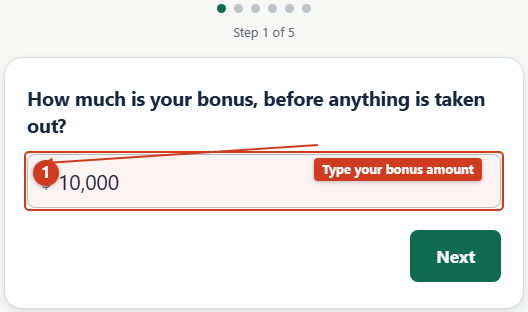
Enter your bonus amount
On the first card, type the bonus you received before any tax was taken out. Here we use a $10,000 bonus.
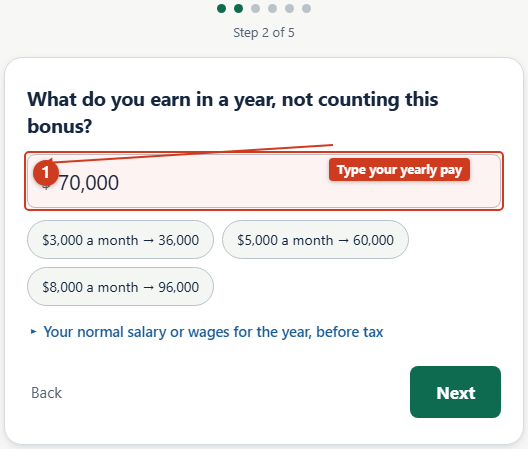
Enter your yearly pay
Click Next and type your annual salary, not counting this bonus. We use $70,000 a year.
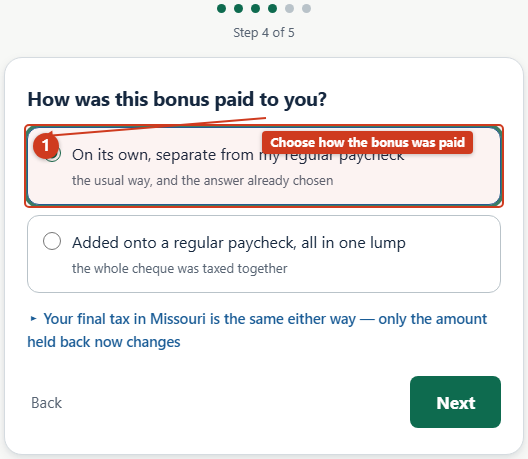
Choose how the bonus was paid
Click Next through filing status. On the payment card, pick how the bonus was paid to you — on its own (the default) or added to a regular paycheck.
Read your estimated take-home bonus
Click Next to the last card. The green figure is your estimated bonus after withholding, with a line-by-line breakdown below it.
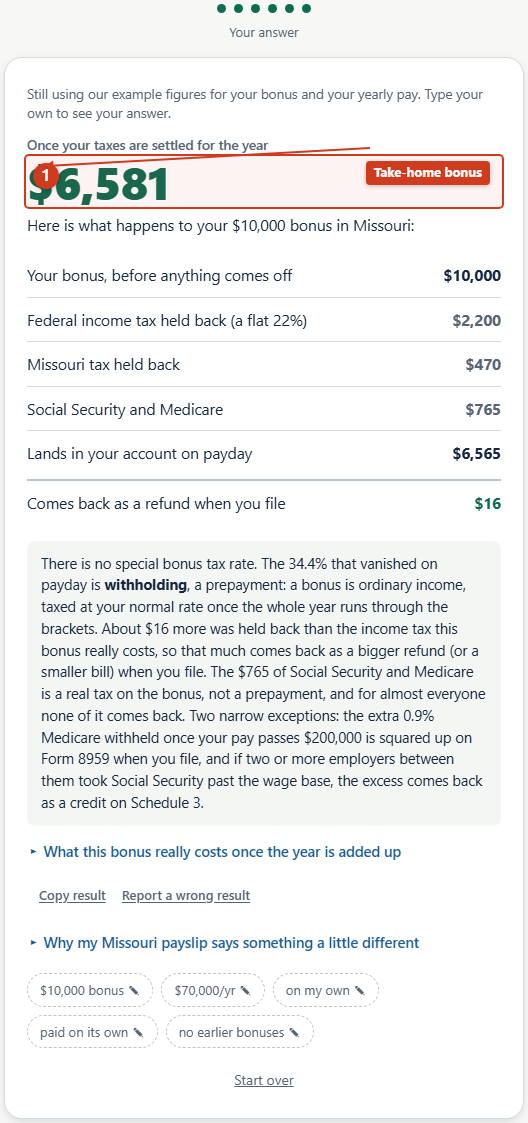
Tip: Enter your bonus and yearly pay, keep single filing and the default 'paid on its own' option, then click through to the answer. The figure is an estimate of take-home bonus pay, not tax advice.
That big bite out of a Missouri bonus is withholding at work — a prepayment, not a special bonus tax. Missouri adds a flat 4.7% on top of the 22% federal prepayment and FICA. Type in your salary and bonus above and the tool lines up today's withholding against your true tax, with the refund or balance due. Everything runs in your browser.
Short version: in Missouri, a bonus paid on its own is withheld at the flat federal 22%, 4.7% for Missouri, and 7.65% FICA. None of that is the final number — a bonus is taxed at your marginal rate once you file, so the calculator above estimates what comes back or is still due.
Estimate only, not tax advice — terms.
Breaking down the withholding on a Missouri bonus
Where the 22% comes from. Employers may withhold a flat 22% of a separately identified bonus for federal income tax (IRS Publication 15). It rises to a mandatory 37% on any bonus dollars past $1,000,000 in a year — the third bracket's rate as a default, not a bonus tax.
The Missouri rate: 4.7%. Missouri Department of Revenue Employer's Tax Guide, Form 4282 has Missouri employers hold back a flat 4.7% on a separately paid bonus.
FICA is the real tax. Social Security (6.2% to the wage base) and Medicare (1.45%, +0.9% above $200,000) are owed at the same rate they're withheld. Neither piece refunds at filing, so both columns of the tool show it unchanged; the income-tax withholding is the only part that trues up.
For your regular salary rather than a bonus, use the Missouri paycheck calculator.
The "Missouri bonus tax" myth, and what's really withheld
A bonus doesn't trigger a different tax — just a flat withholding up front. When you file, it's folded into your income and taxed at your marginal rate through the normal brackets. When 22% overshoots your rate you're refunded; when it undershoots, the balance is due. In this page's $11,000 example, about $1,116 of what's withheld is really over-payment you'd get back. Only FICA (7.65%) is a true tax that never returns.
What Missouri holds back on a $5,000, $25,000, or $100,000 bonus
Three bonuses — $5,000, $25,000, $100,000 — and what Missouri withholds from each on a $70,000 salary:
| Bonus | Federal | Missouri | FICA | Total | % of bonus |
|---|---|---|---|---|---|
| $5,000 | $1,100 | $235 | $383 | $1,718 | 34.4% |
| $25,000 | $5,500 | $1,175 | $1,913 | $8,588 | 34.4% |
| $100,000 | $22,000 | $4,700 | $7,650 | $34,350 | 34.4% |
Watch the percentage fall once Social Security maxes out; the income-tax slice trues up when you file regardless.
Cross-border check: Missouri vs. Kansas, Illinois and Arkansas on a bonus
A single filer earning $70,000 who gets a $10,000 bonus, in Missouri and neighboring Kansas, Illinois and Arkansas:
| State | Bonus method | State withheld | Total withheld |
|---|---|---|---|
| Missouri | flat 4.7% | $470 | $3,435 |
| Kansas | flat 5% | $500 | $3,465 |
| Illinois | aggregate (~4.95%) | $495 | $3,460 |
| Arkansas | flat 3.7% | $370 | $3,335 |
Total combines the 22% federal, the state line, and FICA. Single-filer estimates — your real income tax settles when you file.
A $11,000 bonus on a $36,000 Missouri salary: withheld vs. actually owed
Here's how a $11,000 bonus plays out for a single filer making $36,000 in Missouri:
- On the check: the employer holds back $2,420 for federal, $517 Missouri, and $842 for FICA — $3,779 in all (34.4% of the bonus), leaving about $7,222.
- What it actually costs: the true income tax on the bonus is about $1,821 (federal $1,320 + Missouri $501), plus the same $842 FICA.
- The gap: the flat 22% over-shoots your real rate by about $1,116, so that much is a refund later. FICA ($842) stays either way — it's a real tax.
Illustrative single-filer figures from this page's engine; your result depends on your total income and filing status.
Missouri bonus tax FAQ
Does Missouri tax bonuses more than regular pay?
No. There's no separate, higher tax on bonuses — a bonus is just withheld at a flat rate up front, then taxed like any income at your marginal rate.
What is the Missouri bonus tax rate in 2026?
Missouri withholds 4.7% on a separately paid bonus, on top of the flat 22% federal rate (37% above $1,000,000/yr) and 7.65% FICA. That's withholding, not your final tax.
Does a bonus push my Missouri income into a higher bracket?
No. Brackets are marginal — only the dollars above each threshold are taxed higher. A bonus never re-taxes income you already earned.
Why might I owe tax on my Missouri bonus at filing?
Because 22% is only a prepayment. If your true marginal rate is above 22% (high earners), the flat withholding falls short and you owe the rest; below 22%, you're over-withheld and get money back.
Bonus tax calculators near Missouri
Missouri paycheck calculator · all state bonus tax calculators →
Sources
How we sourced these numbers
Every figure on this page is calculated, not estimated by hand. Federal income-tax withholding follows the IRS Publication 15-T (Federal Income Tax Withholding Methods), which is the method employers use to turn your W-4 and pay into a per-paycheck withholding amount. Brackets and the standard deduction come from the IRS annually; Social Security and Medicare rates and the wage base come from the Social Security Administration; state figures come from each state's revenue or labour agency, linked below. A person updates the underlying tax data and the calculator recomputes every figure at build time. This is an estimate for planning, not tax advice.
- IRS Publication 15 (2026) — Supplemental Wages (flat 22% / 37% above $1M)
- Missouri supplemental rate: Missouri Department of Revenue Employer's Tax Guide, Form 4282 (Revised 03-2026), Section 7A: withhold a flat 4.7 percent on supplemental wages paid separately from regular wages. The same flat 4.7 percent option appears in the 2026 Missouri Withholding Tax Formula.