Kansas Paycheck Calculator
Last updated:
$75,000 a year in Kansas: what is the 2026 take-home pay?
A $75,000 salary in Kansas nets roughly $58,207 a year in 2026, once federal income tax, Social Security and Medicare and Kansas state tax are withheld.
Kansas take-home pay calculator
Take-home now: $2,238.74 per 2 weeks
How to Calculate Your Kansas Take-Home Pay (Step by Step)
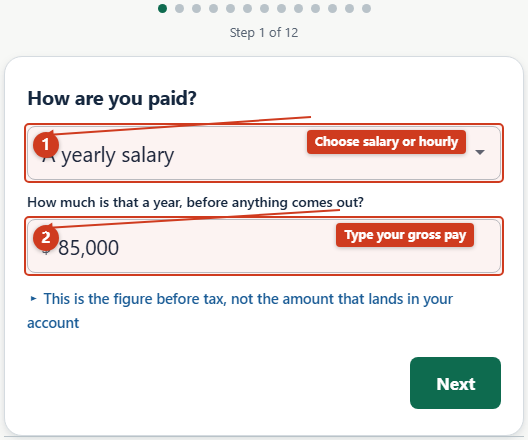
Walk through the Kansas paycheck calculator with a real $85,000 salary example. Each screenshot shows exactly what to type and which option to pick, so you can read your own estimated take-home pay with confidence.
Open the calculator and enter your pay
Start on the first card. Choose how you are paid (salary or hourly) and type your gross pay. Here we use a $85,000 annual salary.
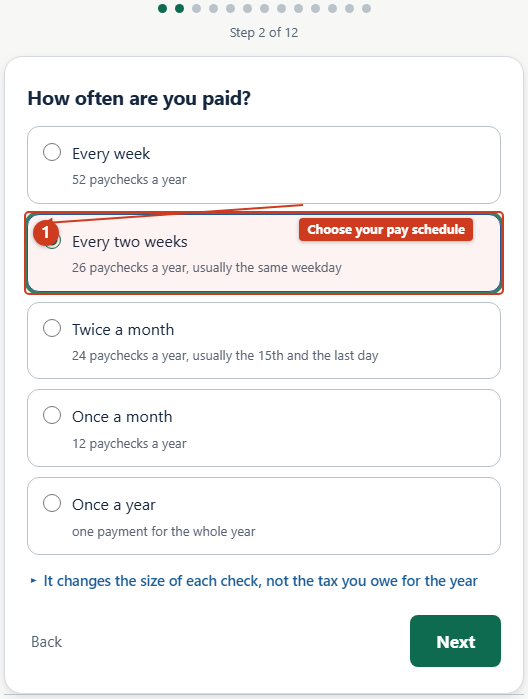
Pick how often you are paid
Click Next and select your pay schedule. Biweekly (26 paychecks a year) is selected in this example.
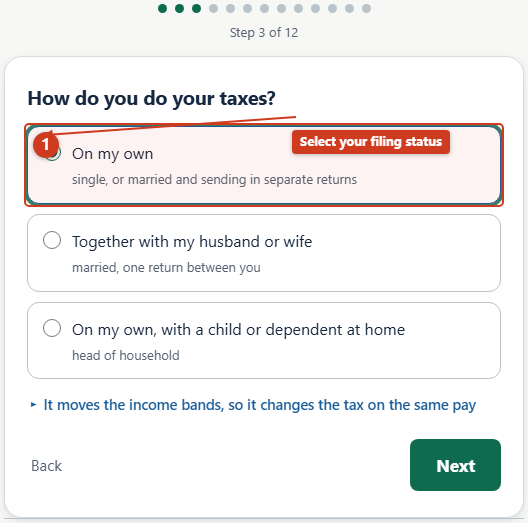
Answer the remaining tax questions
Click Next through filing status, tips, overtime, bonus, retirement and dependents. Pick the option that matches your situation; the defaults below are used here.
Read your estimated take-home pay
Keep clicking Next to the last card. Your estimated net pay per paycheck appears in the green answer band, with a full breakdown of federal, FICA and Kansas deductions below it.
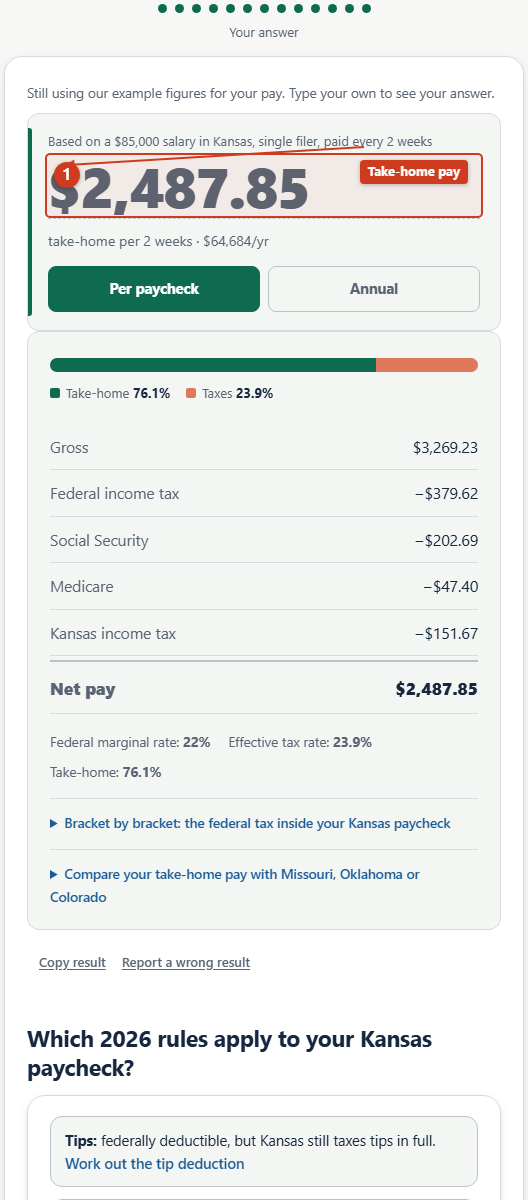
Tip: Enter a yearly salary of $85,000, keep biweekly pay and single filing status, then click through the questions. The result updates instantly — no submit button. Figures are an estimate for planning, not tax advice.
Use this free Kansas (KS) paycheck, payroll and income tax calculator to estimate your 2026 take-home pay after federal income tax, Social Security, Medicare, and Kansas's graduated state income tax (two brackets, 5.2% to 5.58%).
Enter your own pay in the calculator to estimate your Kansas take-home pay for any salary or hourly wage.
Kansas's two-bracket ladder (5.2%–5.58%): what comes out of each 2026 check
Kansas uses graduated 2026 state income-tax brackets, so higher pay is taxed at higher marginal rates after the state deduction. This calculator applies that on top of federal withholding and Social Security / Medicare to estimate your Kansas take-home pay.
Kansas uses a graduated income tax with 2 brackets for 2026, with marginal rates ranging from 5.2% to a top rate of 5.58% (which applies to single-filer taxable income above $23,000). For 2026, Kansas's state standard deduction plus personal exemption is $12,765 for single filers and $26,560 for married couples filing jointly. As a worked example, a single filer earning $60,000 pays about $2,548 in Kansas income tax (roughly 4.2% of gross) before federal tax and FICA.
What this estimate doesn't include: Kansas has no local/city income tax on wages. This estimate includes Kansas's personal exemption, added to the standard deduction: $9,160 single, $18,320 married filing jointly and $11,480 head of household, because a head-of-household filer gets an extra $2,320. With the standard deduction ($3,605, $8,240 and $6,180) that comes to $12,765, $26,560 and $17,660. The extra $2,320 exemption for each dependent is not included. Kansas itemized deductions, tax credits (e.g. child/dependent care), and the additional standard deduction for filers age 65+ or blind are not modeled. City, county or school-district income taxes where they apply, court-ordered deductions, union dues, and anything else your specific employer withholds are not in this figure; your pay stub is the authority on those.
Estimates only, not tax advice. The section "What this estimate doesn't include" above lists what's left out; see also our terms and the corrections log.
Kansas's two 2026 brackets, from 5.2% to 5.58% (single filers)
Kansas's graduated single-filer schedule for 2026, applied after the state deduction:
| Taxable income | Marginal rate |
|---|---|
| $0 – $23,000 | 5.2% |
| $23,000 and above | 5.58% |
Beyond the paycheck: Kansas's 6.5% statewide sales tax
| Statewide sales tax | 6.5% |
One Kansas payroll quirk worth knowing
- Kansas localities can tax interest and dividend income via a local 'intangibles tax' (Form 200, filed with the county clerk), but it explicitly excludes wages, so a paycheck shows no local withholding.
Kansas stays on the federal $7.25 minimum wage in 2026
$7.25/hour (≈$15,080/year full-time). Kansas statutory minimum wage equals the federal $7.25/hr; no change for 2026.
Is overtime and tips tax-free in Kansas? Federally yes, but Kansas still taxes both
For tax years 2025 to 2028 there is a federal deduction for qualified overtime premium pay and tips (OBBBA caps & rules). FICA comes out either way.
Kansas state income tax: Kansas has not adopted the federal tips/overtime deductions for state income tax as of mid-2026, so they reduce your federal tax only. (source: admin.ks.gov)
- Overtime: 2025 — not deductible on your Kansas return (still state-taxed); 2026–2028 — not deductible on your Kansas return (still state-taxed).
- Tips: 2025 — not deductible on your Kansas return (still state-taxed); 2026–2028 — not deductible on your Kansas return (still state-taxed).
Related: tips by state · overtime by state · tips calculator · overtime calculator.
Your paycheck vs the $75,514 Kansas median
| Median household income (2024) | $75,514 |
| Take-home (single filer) | ≈$58,540 |
No city or county income tax anywhere in Kansas
No Kansas city or county levies a local income tax on wages. Some counties, cities and townships do levy a local 'intangibles tax' on income from intangible property (bank interest, dividends, CD earnings) — filed on Form 200 with the county clerk by April 15 if $5+ is due — but it does NOT apply to wages/salary, so it never appears in payroll withholding.
Kansas paycheck FAQ
Why is my take-home pay smaller than my salary in Kansas?
Three things come off the top: federal income tax, FICA (6.2% Social Security up to the annual wage base, plus 1.45% Medicare with no cap) and state income tax. Your W-4 allowances and any pre-tax deductions such as a 401(k) change the figure, so two people on the same Kansas salary can take home different amounts.
How much federal income tax is withheld from a Kansas paycheck?
It depends on your pay, filing status and W-4 settings — not a flat rate. The employer uses the IRS percentage method (Publication 15-T): each paycheck is annualised, the 2026 standard deduction ($16,100 for a single filer) is accounted for, and the result is run through the federal brackets, which top out at 37%. That is a prepayment of your annual tax, trued up when you file.
What is unusual about how Kansas handles payroll taxes?
Kansas taxes income in just two brackets for 2026: 5.20% on the first $23,000 of taxable income for a single filer ($46,000 for a married couple filing jointly) and 5.58% on income above that.
Does Kansas have a state income tax in 2026?
Yes — two graduated brackets from 5.2% to 5.58% in 2026, on top of federal tax and FICA.
Compare a paycheck next door: Missouri, Oklahoma & Colorado
| State | State income tax (2026) | Take-home on $75,000 (single) |
|---|---|---|
| Kansas | two brackets, 5.2%–5.58% | $58,207 |
| Missouri | eight brackets, 0%–4.7% | $59,059 |
| Oklahoma | four brackets, 0%–4.5% | $58,763 |
| Colorado | flat 4.4% | $58,671 |
| Nebraska | four brackets, 2.46%–4.55% | $58,884 |
Those are the states next door. To see where Kansas lands against all of them at once, our take-home pay by state study runs an identical salary at two levels, $75,000 and $100,000, through the 2026 rules of every state and DC, except Arizona, Arkansas, Idaho, Maryland, Ohio and Vermont, still on their 2025 tables, ranked from the most take-home pay to the least.
All state paycheck calculators →
Data compiled and maintained by Timmy · Updated
Sources
How we sourced these numbers
Every figure on this page is calculated, not estimated by hand. Federal income-tax withholding follows the IRS Publication 15-T (Federal Income Tax Withholding Methods), which is the method employers use to turn your W-4 and pay into a per-paycheck withholding amount. Brackets and the standard deduction come from the IRS annually; Social Security and Medicare rates and the wage base come from the Social Security Administration; state figures come from each state's revenue or labour agency, linked below. A person updates the underlying tax data and the calculator recomputes every figure at build time. This is an estimate for planning, not tax advice.