Illinois Paycheck Calculator
Last updated:
What is the take-home pay on $75,000 in Illinois in 2026?
Earning $75,000 in Illinois? Your estimated 2026 take-home is about $58,025 after federal tax and FICA, and Illinois state income tax.
Illinois take-home pay calculator
Take-home now: $2,231.72 per 2 weeks
How to Calculate Your Illinois Take-Home Pay (Step by Step)
Walk through the Illinois paycheck calculator with a real $85,000 salary example. Each screenshot shows exactly what to type and which option to pick, so you can read your own estimated take-home pay with confidence.
Open the calculator and enter your pay
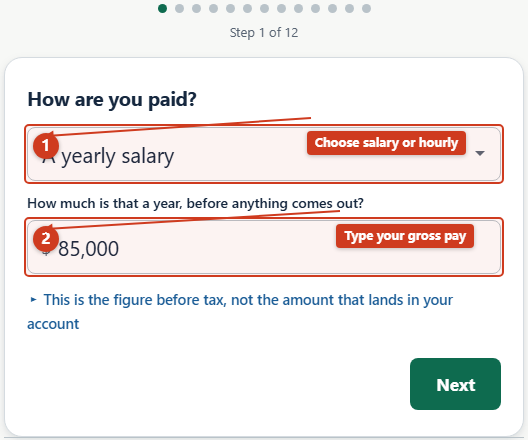
Start on the first card. Choose how you are paid (salary or hourly) and type your gross pay. Here we use a $85,000 annual salary.
Pick how often you are paid
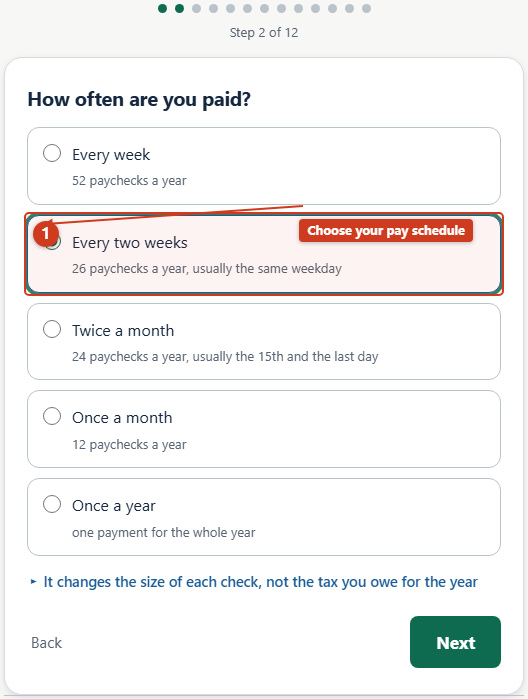
Click Next and select your pay schedule. Biweekly (26 paychecks a year) is selected in this example.
Answer the remaining tax questions
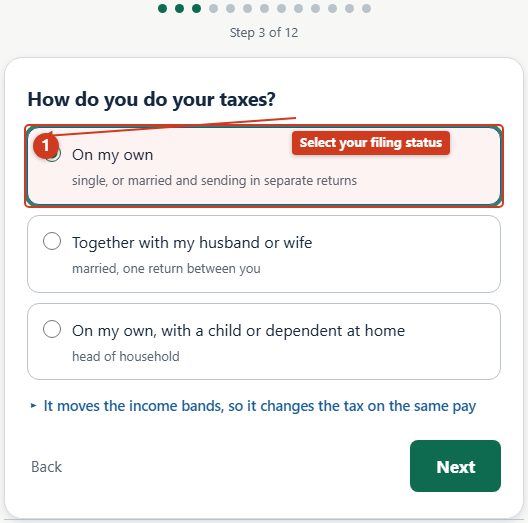
Click Next through filing status, tips, overtime, bonus, retirement and dependents. Pick the option that matches your situation; the defaults below are used here.
Read your estimated take-home pay
Keep clicking Next to the last card. Your estimated net pay per paycheck appears in the green answer band, with a full breakdown of federal, FICA and Illinois deductions below it.
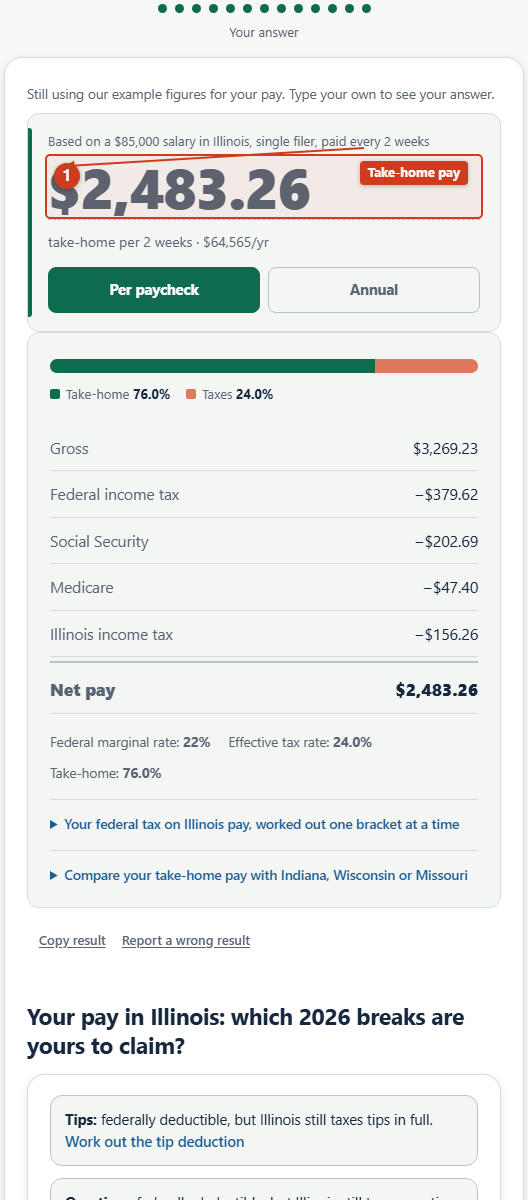
Tip: Enter a yearly salary of $85,000, keep biweekly pay and single filing status, then click through the questions. The result updates instantly — no submit button. Figures are an estimate for planning, not tax advice.
Use this free Illinois (IL) paycheck, payroll and income tax calculator to estimate your 2026 take-home pay after federal income tax, Social Security, Medicare, and Illinois's flat 4.95% state income tax.
Enter your own pay in the calculator to estimate your Illinois take-home pay for any salary or hourly wage.
How Illinois's flat 4.95% income tax hits your 2026 paycheck
Illinois levies a flat 4.95% state income tax for 2026, applied after the state allowance/deduction for your filing status. This calculator applies that on top of federal withholding and Social Security / Medicare to estimate your Illinois take-home pay.
For 2026, Illinois's state personal exemption is $2,925 for single filers and $5,850 for married couples filing jointly, with none at all above $250,000 of income (above $500,000 for married couples filing jointly); after that, all remaining taxable income is taxed at the single flat rate of 4.95% — Illinois does not use graduated brackets for 2026. As a worked example, a single filer earning $60,000 pays about $2,825 in Illinois income tax (roughly 4.7% of gross) before federal tax and FICA.
What this estimate doesn't include: Estimate assumes 1 personal exemption allowance ($2,925) for single/head of household and 2 for married filing jointly. Illinois allows no exemption at all once federal adjusted gross income is over $250,000 ($500,000 for married couples filing jointly), and this estimate applies that. City, county or school-district income taxes where they apply, court-ordered deductions, union dues, and anything else your specific employer withholds are not in this figure; your pay stub is the authority on those.
Estimates only, not tax advice. The section "What this estimate doesn't include" above lists what's left out; see also our terms and the corrections log.
One rate on every taxable dollar: Illinois's 4.95% flat tax (2026)
Illinois applies a single flat rate to taxable wages for 2026.
| Filing | Rate |
|---|---|
| All taxable income | 4.95% |
No city or county income tax anywhere in Illinois
No municipality or county in Illinois levies a local income or wage tax — Chicago and Cook County impose no city wage tax on employees. All wage income is taxed only at the flat state rate of 4.95%.
Illinois's own $15.00 minimum wage — above the federal floor (2026)
$15.00/hour (≈$31,200/year full-time). Statewide $15.00/hr, unchanged since it reached that level on Jan 1, 2025, completing the 2019 phase-in. Jan 1, 2026 was a no-change year, and there is no state CPI indexing afterward, but Chicago ($17.05 as of July 1, 2026) and Cook County ($15.40) set higher local minimums.
Two Illinois payroll quirks worth knowing
- Illinois's constitution requires a flat income tax ('A tax on or measured by income shall be at a non-graduated rate'), so every Illinois worker pays the same 4.95% state rate on wages, whatever they earn, and no Illinois city or county adds a local income tax.
- Illinois has no employee-side payroll deductions for disability, paid family leave, or unemployment — SUI is fully employer-paid (0.750%-7.050% on the first $14,250 of wages in 2026), so an Illinois paycheck shows only the flat 4.95% state income tax beyond federal items.
Is overtime and tips tax-free in Illinois? Federally yes, but Illinois still taxes both
For tax years 2025 to 2028 there is a federal deduction for qualified overtime premium pay and tips (OBBBA caps & rules). FICA comes out either way.
Illinois state income tax: Illinois has not adopted the federal tips/overtime deductions for state income tax as of mid-2026, so they reduce your federal tax only. (source: tax.illinois.gov)
- Overtime: 2025 — not deductible on your Illinois return (still state-taxed); 2026–2028 — not deductible on your Illinois return (still state-taxed).
- Tips: 2025 — not deductible on your Illinois return (still state-taxed); 2026–2028 — not deductible on your Illinois return (still state-taxed).
Related: overtime calculator · tips calculator · overtime by state · tips by state.
Beyond the paycheck: Illinois's 6.25% statewide sales tax
| Statewide sales tax | 6.25% |
Your paycheck vs the $83,211 Illinois median
| Median household income (2024 (ACS 1-year)) | $83,211 |
| Take-home (single filer) | ≈$63,395 |
Illinois paycheck FAQ
Does Illinois have a state income tax in 2026?
Yes — a flat 4.95% on taxable wages in 2026, on top of federal tax and FICA.
What does a full-time minimum-wage job in Illinois pay in 2026?
Illinois's 2026 minimum wage is $15.00/hour — about $31,200 a year at 40 hours a week before taxes. Details and exceptions are in the minimum-wage section above.
How much federal income tax is withheld from a Illinois paycheck?
It depends on your pay, filing status and W-4 settings — not a flat rate. The employer uses the IRS percentage method (Publication 15-T): each paycheck is annualised, the 2026 standard deduction ($16,100 for a single filer) is accounted for, and the result is run through the federal brackets, which top out at 37%. That is a prepayment of your annual tax, trued up when you file.
Why is my take-home pay smaller than my salary in Illinois?
Three things come off the top: federal income tax, FICA (6.2% Social Security up to the annual wage base, plus 1.45% Medicare with no cap) and state income tax. Your W-4 allowances and any pre-tax deductions such as a 401(k) change the figure, so two people on the same Illinois salary can take home different amounts.
Compare a paycheck next door: Indiana, Wisconsin & Missouri
| State | State income tax (2026) | Take-home on $75,000 (single) |
|---|---|---|
| Illinois | flat 4.95% | $58,025 |
| Indiana | flat 2.95% | $59,410 |
| Wisconsin | four brackets, 3.5%–7.65% | $58,612 |
| Missouri | eight brackets, 0%–4.7% | $59,059 |
| Iowa | flat 3.8% | $59,354 |
Those are the states next door. To see where Illinois lands against all of them at once, our take-home pay by state study runs an identical salary at two levels, $75,000 and $100,000, through the 2026 rules of every state and DC, except Arizona, Arkansas, Idaho, Maryland, Ohio and Vermont, still on their 2025 tables, ranked from the most take-home pay to the least.
All state paycheck calculators →
Data compiled and maintained by Timmy · Updated
Sources
How we sourced these numbers
Every figure on this page is calculated, not estimated by hand. Federal income-tax withholding follows the IRS Publication 15-T (Federal Income Tax Withholding Methods), which is the method employers use to turn your W-4 and pay into a per-paycheck withholding amount. Brackets and the standard deduction come from the IRS annually; Social Security and Medicare rates and the wage base come from the Social Security Administration; state figures come from each state's revenue or labour agency, linked below. A person updates the underlying tax data and the calculator recomputes every figure at build time. This is an estimate for planning, not tax advice.